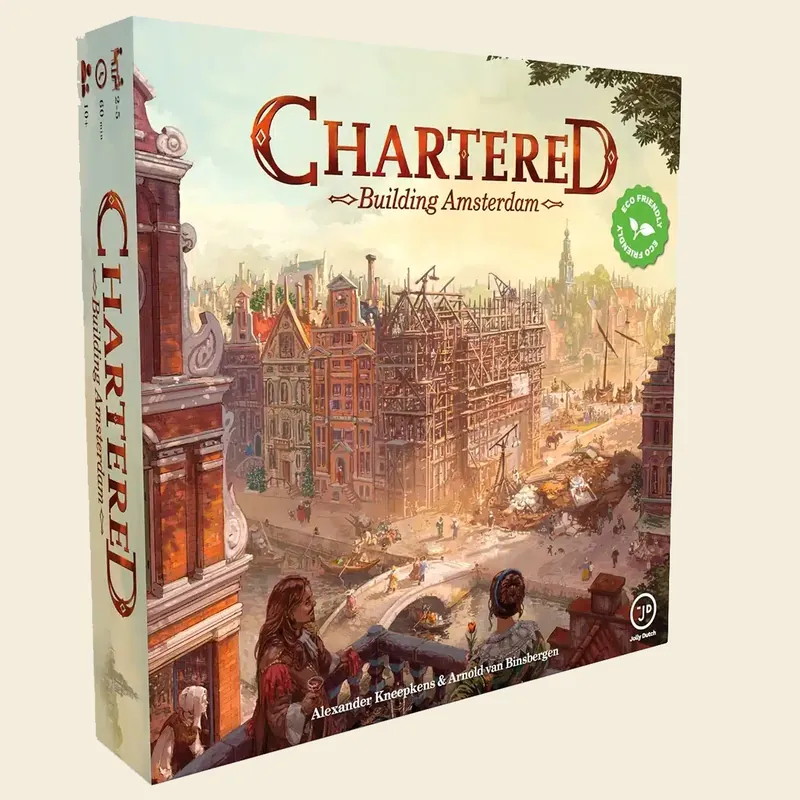
Building Amsterdam is the 2024 box. Two to five players, age 10+, about 60 minutes. The linked BoardGameGeek entry carries the current community rating. Designers are Alexander Kneepkens and Arnold van Binsbergen. Art is by Odysseas Stamoglou and Nicholas Westgård. A BGG language poll says no in-game text is required.
| Part | Count | Status |
|---|---|---|
| Modular boards | 4 | Rulebook · 1 source |
| Ordinary warehouses | 62 | Rulebook · 1 source |
| Broken roofs | 10 | Rulebook · 1 source |
| Building cards | 114 | Rulebook · 1 source |
| Share-event cards | 15 | Rulebook · 1 source |
| Action cards | 10 | Rulebook · 1 source |
| Coins | 150 | Rulebook · 1 source |
| Companies | 9 | Rulebook · 1 source |
Nine companies and a turn
The companies are Gunpowder, Silk, Herring, Coal, Spices, Tea, Porcelain, Sugar, and Tobacco. On your turn you buy building cards (ƒ50 for two, or a single level card if one is in the open market), play a building card to place a warehouse, or sell up to two shares.
Placing a warehouse can found a company, grow one, merge, or leave an isolated warehouse. A new company usually starts from two warehouses at ƒ10 each, so ƒ20, and it may be founded on a diagonal. That founding turn is the one moment you play two building cards. You may then buy up to two shares at the real value.
Growth is ƒ10 per warehouse, plus ƒ20, ƒ30, or ƒ40 from a level card, with a ceiling of ƒ300. Past the ceiling there is no payout. In a merger the higher company absorbs the lower one. Shares of the lower company can be sold back at the current value, and the player who merges takes the new value as a payout. Three companies merge from the lowest pair upward.
The cheapest share purchase is ƒ50. Buying and selling does not move the company value. Your hand caps at 15 cards and you cannot discard. Share events fire when a rising value crosses a line on the share track. The player who caused it chooses the open event or a draw, and the card is a bid, an auction, or a trade.
Each player holds two action cards. After placing a warehouse you may pay ƒ100 to either take a broken roof or fire a share event at once. A broken roof drops that company by ƒ50, and a company cannot fall below ƒ20. The difference sheet says each player may place at most two broken roofs. The end is the last warehouse. Sell shares back from the poorest company upward. The richest player wins. A tie goes to the smaller hand, then a shared win.
Tabletopping calls it medium weight, easy to teach, with hidden shares and a modular map, and prints no numeric score. Dice Tower’s Graeme scores it 6.0 for 2024, 2–5 players, age 10+. That 6.0 is one reviewer’s number, not a BoardGameGeek average.
Questions
What does it cost?
The publisher listed €29.95. Philibert listed €39.95 for the 2nde Edition, EAN 8720938477119. Each price has one shop source, checked 17 November 2026.
Why do play times vary?
The publisher lists 60 minutes; Philibert lists 30–60 minutes for the 2nde Edition. The earlier research captured 60–90 minutes at Zatu, whose page was rate-limited on this review.
Related guides
Sources
Checked 17 November 2026.
- Jolly Dutch product page
- English rulebook PDF
- Differences PDF
- BoardGameGeek 426330
- Tabletopping review
- Dice Tower review by Graeme
- Philibert 2nde Edition
- Zatu
Limitation: Rules, prices and availability are as published on the dated sources above and can change without notice.